
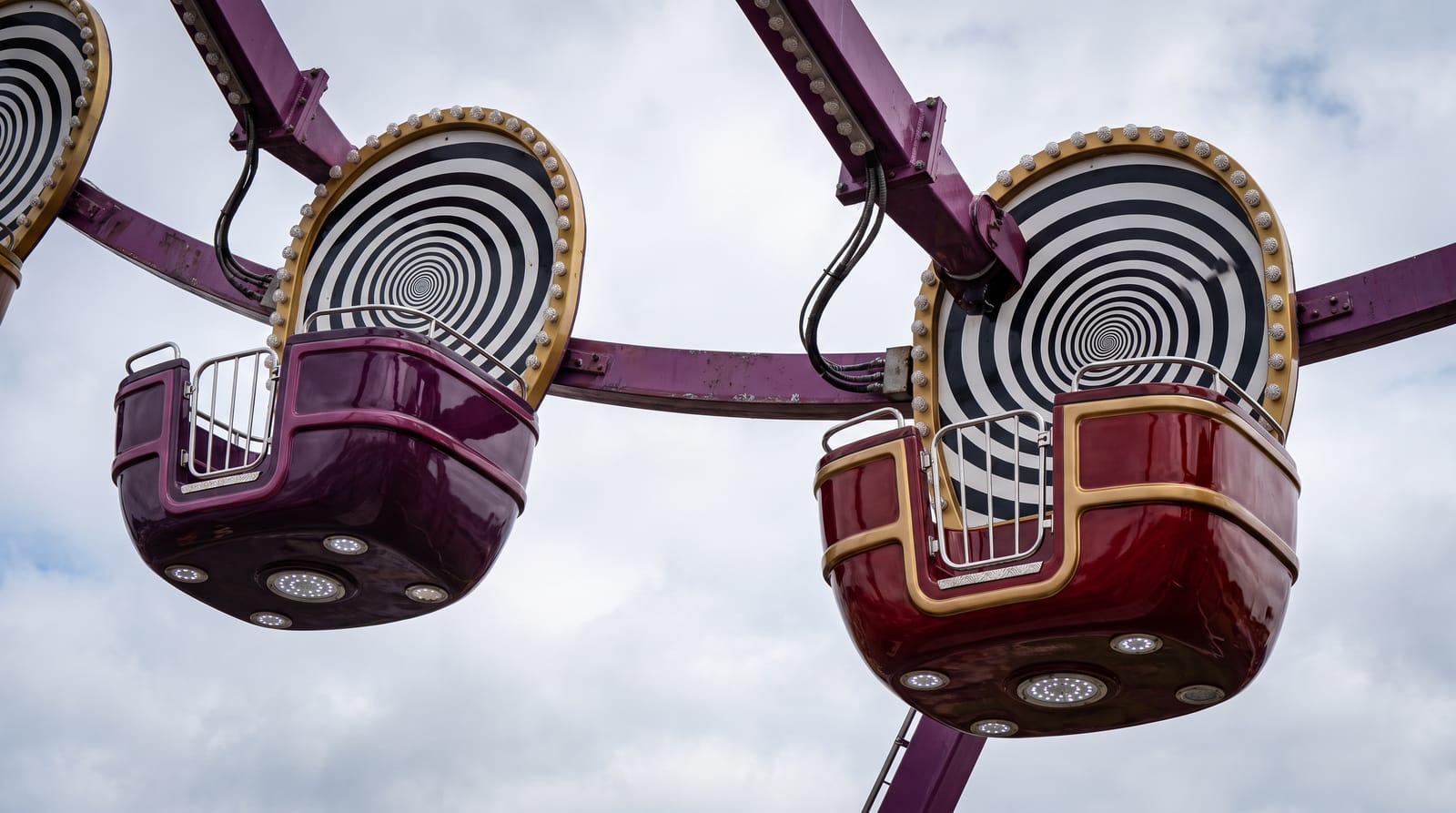
The most quietly successful ride of the past few years is one you may have ridden without learning its name. Zamperla has now built its bigger sibling, and the interesting part is what the company took off it.
The Italian manufacturer presented Hypnosiz at IAAPA Expo in Orlando on 17 November, as the centrepiece of its 60th anniversary. It is a flat ride, the trade’s term for a ride that spins or swings on a fixed base instead of running along a track. Zamperla describes it as the next step on from its Nebulaz, with twice the seats.
What happened
Orlando was the trade-show outing, not the first sighting. Italian business daily Il Sole 24 Ore reports that the world premiere was on 12 September, at Zamperla’s headquarters in Altavilla Vicentina near Vicenza, after 18 months of development involving 85 suppliers. Zamperla’s own photographs show a full-size machine standing outside its factory buildings, so this is a built prototype, not a rendering.
Antonio Zamperla, the company’s president and chief executive, told trade site Blooloop what the brief was: “We wanted something bigger, with more capacity, more presence, and much more visual impact.” In the Orlando announcement he called it “one of the experiences with which we begin the next chapter.”
No buyer has been named. None of the announcements we found says where the first Hypnosiz will operate, or when.
The detail
Every figure below is from Zamperla’s own product pages for the two rides.
| Nebulaz | Hypnosiz | |
|---|---|---|
| Riders per cycle | 32 | 64 |
| Theoretical capacity | 360 per hour | 650 per hour |
| Height | 10.2 m (33 ft) | 11.4 m (37.4 ft) |
| Footprint (diameter) | 12.8 m (42 ft) | 16 m (52.5 ft) |
| Ride time | 158 seconds | 116 seconds |
| Load and unload | 160 seconds | 4 × 60 seconds |
| Arm rotation | 12.5 rpm | 11 rpm |
| Restraint | Over-the-shoulder, monitored | Self-retracting seat belts, automatic release |
| Minimum rider height | 105 cm (42 in) | 105 cm (42 in); 120 cm (48 in) alone |
| Power requirement | 72 kW | 138 kW |
The Nebulaz, launched in 2019, has four pendulum arms on a slowly turning central tower, with a four-seat gondola at each end of each arm. Enthusiast wiki Coasterpedia counts 30 in operation. In Britain you may know it as Loki at Drayton Manor. Hypnosiz keeps the idea but seats its riders face to face in open gondolas.
What it actually means
Start with the capacity, because the headline number flatters a little. Theoretical capacity is the manufacturer’s figure for every seat filled and every cycle on time, and you can rebuild it from the table. A Nebulaz cycle is 158 seconds of ride plus 160 of loading: 318 seconds, a little over 11 cycles an hour, 360 riders. A Hypnosiz cycle is 116 plus 240: 356 seconds, about 10 cycles an hour, 650 riders.
So Hypnosiz has double the seats but 81% more hourly capacity, not 100%. The whole gain comes from the seat count. Each cycle is actually slower, because loading takes 80 seconds longer, and Zamperla has clawed back part of that by cutting 42 seconds off the ride itself. You get a shorter go, and the queue moves faster. Parks will take that trade every time.
The “4 × 60 seconds” line is worth a second look. Our reading is that the ride loads in four stages, a quarter of the gondolas at ground level each time. Zamperla doesn’t spell that out, but its page does say the design keeps loading short “by optimizing movements”.
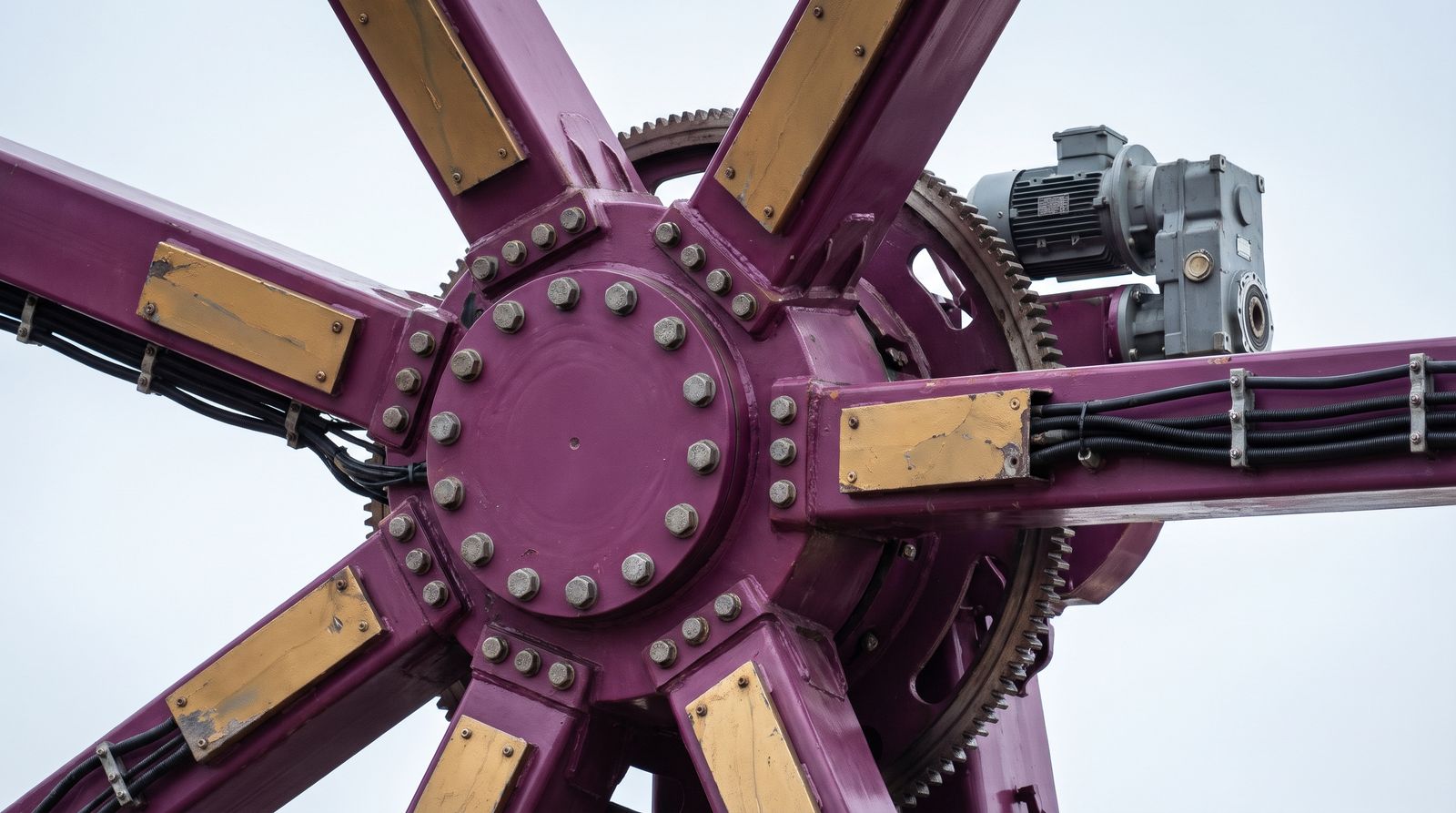
The restraint is the bigger change. The Nebulaz holds riders with over-the-shoulder harnesses that the control system monitors. Hypnosiz uses retracting seat belts that release automatically at the end of the cycle. A belt is quicker to fasten and check than a harness, and it only makes sense on a ride with gentle forces whose gondolas stay upright. Zamperla says the seating, restraint and floor “change the feel of the ride” while keeping the Nebulaz’s “energy profile”. Translated: the same motion, sold to a broader family audience. The minimum height hasn’t moved, at 105 cm, and riders under 120 cm need a companion.
Then there is the claim that it does all this with “less mechanical complexity”. Zamperla has not said what it removed. Il Sole 24 Ore reports only that the geometry and architecture were simplified and systems and components taken out. The claim is plausible on its face. Fewer harnesses means fewer locking mechanisms and sensors to inspect every morning. But the rest of the evidence points the other way: Coasterpedia describes Hypnosiz as having twice as many arms as the Nebulaz, a figure Zamperla’s spec sheet doesn’t give, and the power requirement has nearly doubled, from 72 kW to 138 kW. Simpler per seat, perhaps. Simpler outright is unproven until a maintenance team has lived with one.
The business case is easier to see. The footprint grows from 12.8 m to 16 m across, which is about 56% more ground for twice the riders. And Zamperla has momentum: Il Sole 24 Ore puts group turnover at €108 million in 2025, with €130 million expected this year, more than 97% of it earned outside Italy.
The Dispatch verdict
Hypnosiz is a sensible sequel. It takes a ride that sold well, makes it carry twice as many people, and replaces the harness with a belt that is quicker to load. Those are the things park operators actually ask for, which is not always true of anniversary showpieces.
Treat two claims with care until a park is running one. The 650 riders an hour is a ceiling that assumes four clean 60-second loads, every cycle, all day. And “less complexity” is so far an assertion with no parts list behind it. The first buyer’s uptime figures will settle both. For now, there is no first buyer to ask.
Further reading: how theme parks calculate ride capacity, how ride restraints actually work, Zamperla’s Double Heart coaster at Lotte World Adventure Busan, and a guide to the roller coaster manufacturers.