
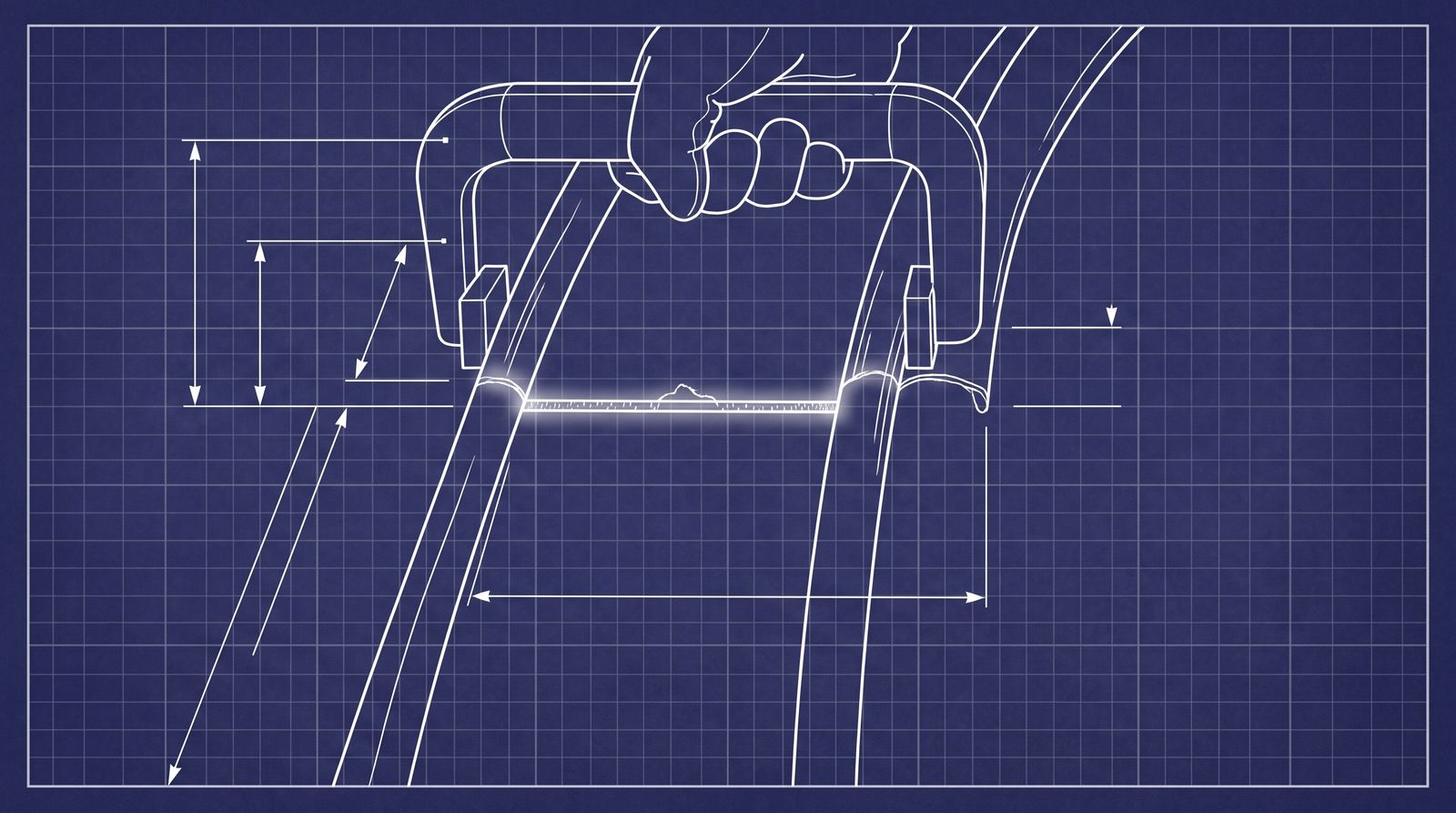
You’re standing at the front of the queue, the train ahead has just cleared the station empty for the second time this morning, and a small, entirely reasonable thought arrives: is anyone actually checking this thing, or are we all just trusting the paint job?
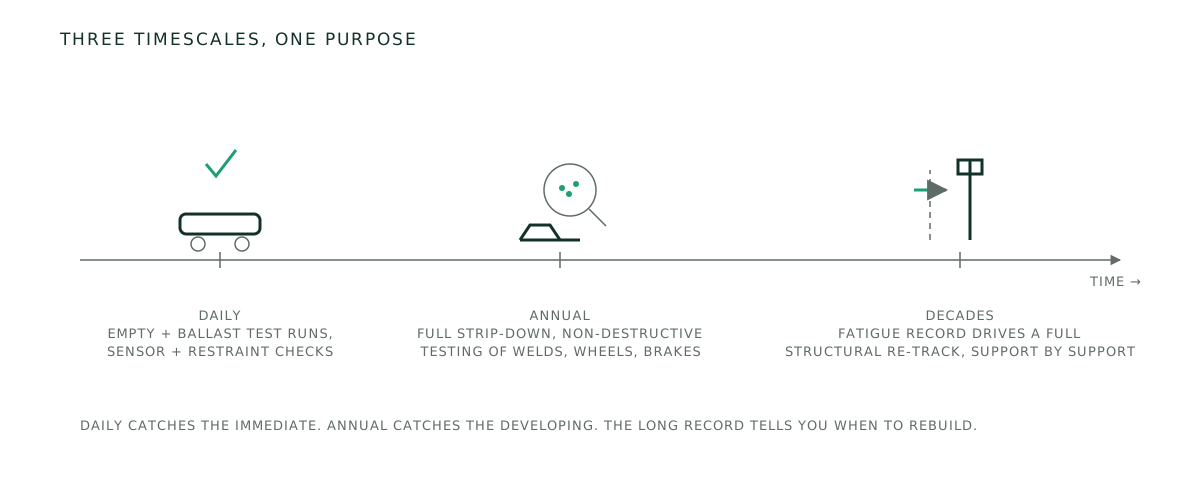
The short answer: yes, constantly, on three overlapping timescales — every single morning before you arrive, every year the ride comes apart for a forensic strip-down, and every couple of decades in a full structural rebuild. None of those checks are optional, and in most of the world they’re not even the park’s call to skip.
Here’s how the checking actually works, who’s legally on the hook for it, and why the three biggest markets — Britain, the EU and the United States — police it in three genuinely different ways.
Every morning, before a single guest arrives
Long before the gates open, an empty train runs the circuit — usually two or three times — with nobody aboard. It sounds like the least useful test imaginable, but it isn’t: an unloaded train has less momentum to carry it over hills and round the circuit than a full one, so if anything in the geometry or the braking has drifted even slightly, the empty run is the one that struggles first, not the one that hides the problem.
Then comes the version with weight. Rather than risk staff on an unproven cycle, parks load the seats with ballast — sandbags or water-filled dummies built to roughly match a rider’s mass — and run the circuit again to confirm the train handles a realistic load the way it’s supposed to. Only once both runs come back clean does a ride move on to test riders, and only after that does it open to the public.
Woven through those laps is a checklist that has nothing to do with track geometry: every restraint sensor reporting locked correctly, every limit switch — the sensor that tells the control system a train has actually reached a given point on the track — responding where it should, and the block system refusing to dispatch a second train into an occupied section. This is the layer that repeats every day the ride runs, for as long as the ride exists.
The annual strip-down: what non-destructive testing actually finds
Once a year, most coasters go further than a test run — the train comes off the track entirely for a full mechanical strip-down, and the structure itself gets examined by people whose whole job is finding damage nobody can see.
The tool for that job is non-destructive testing (NDT) — a family of inspection methods that check a metal part for hidden flaws without cutting it open or damaging it. The two workhorses on a coaster are:
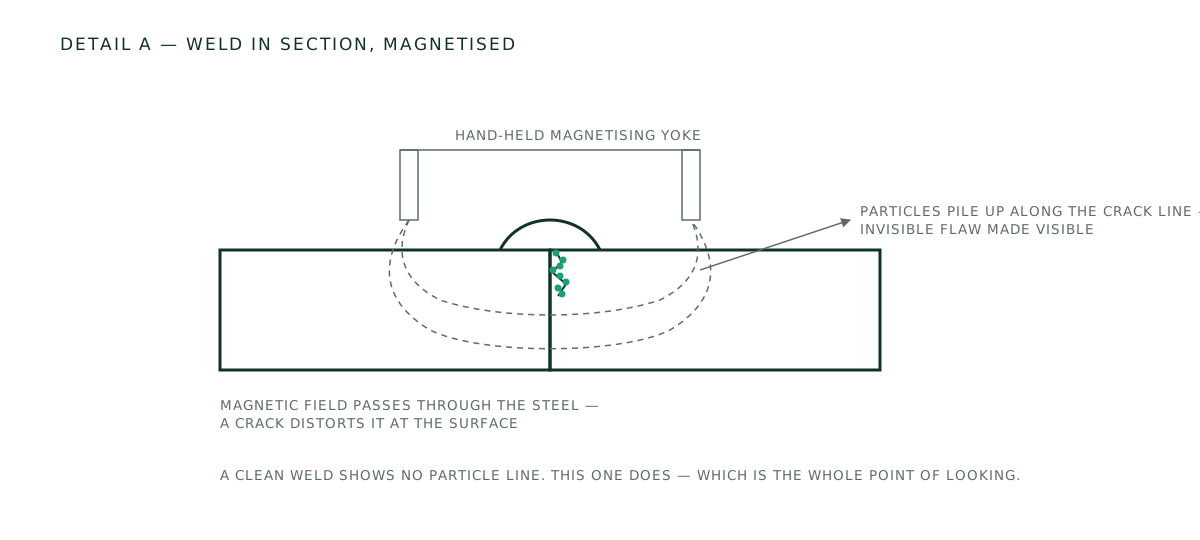
- Magnetic particle inspection (MT): the inspector magnetises a steel part — a weld, an axle, a support base — then dusts it with fine iron particles. A surface or near-surface crack distorts the magnetic field enough that particles pile up along the crack line, making an invisible flaw visible to the naked eye.
- Ultrasonic testing (UT): a probe sends high-frequency sound through the metal and reads what bounces back. A solid part returns one clean echo from the far side; a crack or void inside the metal — invisible from outside entirely — reflects some of that sound early, showing up as a second signal on the display.
Parks also use dye penetrant testing (a coloured liquid that seeps into a surface crack and shows under UV light), eddy current testing (an electrical version of the ultrasonic idea, good on thin material) and old-fashioned radiography — X-raying a weld — where the geometry calls for it. None of these are exotic industrial techniques borrowed for the occasion; they’re the same methods aerospace and rail engineers use to certify the parts that carry them, applied to the same category of problem: fatigue, the slow accumulation of microscopic damage from millions of load cycles, which is a coaster’s actual long-term enemy far more than any single dramatic failure.
Where the checks concentrate
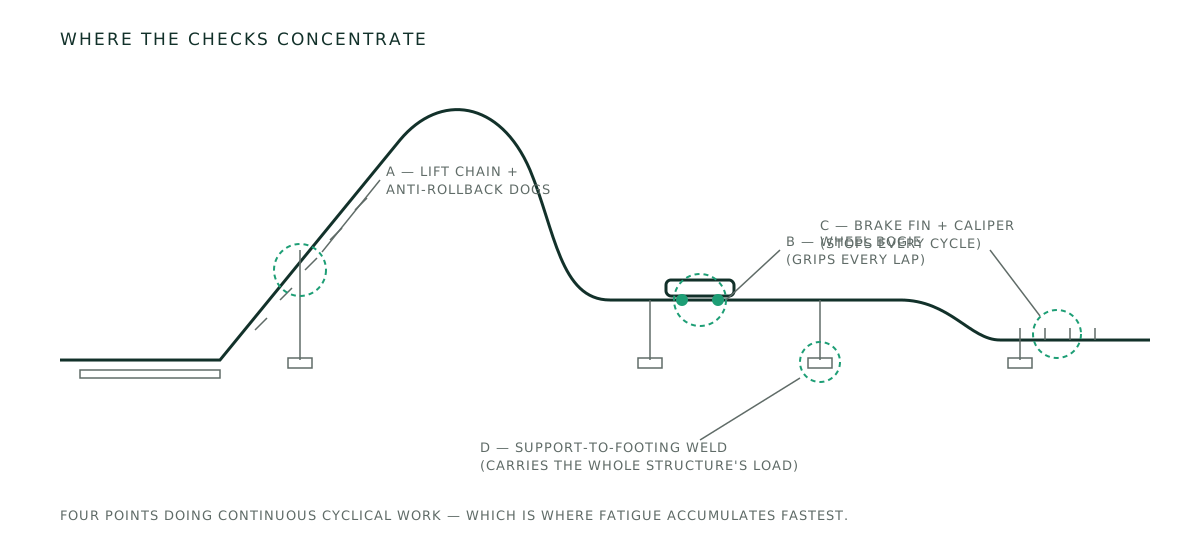
Not every metre of track gets equal attention, because not every metre carries equal risk. Inspectors concentrate on the places doing continuous, cyclical work: the wheel bogies gripping the rail on every lap, the chain dogs and anti-rollback mechanisms on the lift, the brake fins and caliper mounts absorbing a full stop hundreds of times a day, and the welded joints where a support meets the footing — the point that carries the whole structure’s load into the ground.
Britain’s system: ADIPS and the Declaration of Operational Compliance
The UK runs its fairground and theme park rides through the Amusement Device Inspection Procedures Scheme (ADIPS), set up under the industry’s Amusement Device Safety Council and supported by the Health and Safety Executive (HSE). It’s often described, not unfairly, as an MOT for rides: an independent, ADIPS-registered inspection body examines every safety-critical part and function once a year, and if the ride passes, it’s issued a Declaration of Operational Compliance (DOC) — the certificate a ride controller needs to show the ride meets the requirements of the Provision and Use of Work Equipment Regulations 1998 (PUWER).
The inspectors doing that work are typically chartered engineers registered with the National Association for Leisure Industry Certification (NAFLIC), working to the HSE’s own guidance document, HSG175, first published in 1997. Crucially, ADIPS inspection is entirely independent of the ride’s owner and operator — the same separation of interests that makes an MOT test trustworthy rather than a rubber stamp.
Europe’s system: EN 13814 and third-party certification
Continental Europe runs on a harmonised standard, EN 13814, published in three parts covering design and manufacture, operation and maintenance, and inspection. Rather than a single national scheme, compliance is verified by accredited third-party certification bodies — TÜV, most visibly, though it isn’t the only one — who reinspect a ride at an interval set by its complexity, typically somewhere between one and three years for a major coaster.
The practical effect is similar to Britain’s system even though the institutions differ: a ride can’t legally run without a current, independent sign-off from an engineer who answers to nobody at the park.
America’s patchwork: ASTM F24, and the states that opted out
The United States has no single federal body doing what ADIPS or EN 13814 do. Instead, the ASTM F24 committee publishes consensus standards — F770 covers ownership, operation, maintenance and inspection; F2291 covers design — and it’s down to individual states whether to adopt them. Most do: roughly 38 states write ASTM F24 into law in some form. A handful, including Alabama, Mississippi, Montana, Nevada, Wyoming and Utah, have no state-level ride inspection requirement at all for fixed-site parks, on the reasoning that they have few enough parks that it hasn’t seemed worth legislating.
It’s the one genuinely interesting American exception to an otherwise rigorous global picture, and it says something about the analyst’s job on this beat: “is this ride safe” and “who is legally required to have checked” are different questions, and the second one has a real, state-by-state answer that’s worth knowing before you assume regulation is uniform just because the ride looks the same everywhere.
| System | Where | Governing document(s) | Who signs off | Typical interval |
|---|---|---|---|---|
| ADIPS | UK | HSG175 / PUWER 1998 | Independent ADIPS-registered inspection body | Annual, plus daily park checks |
| EN 13814 | EU / EEA | EN 13814-1, -2, -3 | Accredited certification body (e.g. TÜV) | 1–3 years, by ride complexity |
| ASTM F24 | USA | F770 / F2291 | State inspector, or none in 6 states | Varies by state; not federally mandated |
Wood is a different inspection problem entirely
Steel fatigue and timber decay are not the same enemy, which is why a wooden coaster is inspected differently rather than less. NDT crack detection is largely a steel-and-weld discipline; wood inspection leans on visual assessment for splitting, moisture ingress and rot, supplemented by boring small test holes in structural timbers to check for decay hidden under sound-looking surface wood. Bolted joints — thousands of them, on a big traditional woodie — get individually checked and re-torqued on a rolling schedule, because a joint working loose is wood’s version of a fatigue crack: slow, cumulative, and invisible until someone specifically looks.
When inspection becomes engineering: Nemesis Reborn
Inspection doesn’t only catch problems — sometimes it produces the case for rebuilding a ride before there is one. Nemesis, B&M’s inverted coaster at Alton Towers, opened in March 1994. By the early 2020s, three decades of inspection and fatigue data on the original track led the park to submit planning applications for a full re-track rather than a patch-and-repair cycle.
The ride closed in November 2022 and reopened as Nemesis Reborn in March 2024. The rebuild replaced the coaster’s track from the crest of the lift hill to the start of the brake run, swapped out 89 of the ride’s 117 supports, and removed and re-fitted 636 structural bolts. The new track was also sand-filled — packing the tubular steel rail with sand to damp vibration — a noise-reduction technique that wasn’t in common use when the original opened in 1994.
That’s the honest end state of a rigorous inspection regime: not a ride that never needs work, but a park that knows exactly which 89 supports needed replacing and why, decades before anything would have failed on its own.
The Dispatch verdict
What’s genuinely clever about coaster safety engineering isn’t any single test — it’s that the system doesn’t rely on any one of them catching everything. A daily test run catches what’s gone wrong since yesterday; an annual NDT strip-down catches what’s been quietly developing for months; three decades of both, kept as records, eventually tell an engineer exactly which 89 supports on a specific ride need replacing before anyone’s guessed wrong. Three independent nets, each looking for a different kind of failure, on three different clocks. It’s a slower, less dramatic story than a single dramatic safety feature — and that’s rather the point.
Further reading: how block systems keep coaster trains apart, how coaster wheels grip the rail, how restraints lock and why, wood vs steel vs RMC hybrid: what actually changes, and what it took to recertify a 1995 coaster crossing from Britain’s ADIPS regime into Belgium’s EN 13814 one.