
Crest a hill on a coaster and, for a second or two, you stop sitting on the train and start hovering above it. Nothing is pulling you up. So what is?
The short answer: airtime happens when the track drops away from you faster than gravity alone would drop you, so the seat falls away from beneath you and your body is left behind. It’s engineered by shaping the crest of a hill, and it’s the opposite of the crushing force you feel in the valley below.
That’s the whole trick, and a surprising amount of coaster design is a negotiation over it. Here’s how the hill shape, the speed and the restraint divide up the work.
Airtime is a missing force, not an extra one
When you sit still, the seat pushes up on you with a force equal to your weight. That’s 1 g — one unit of ordinary gravity. Everything you feel on a coaster is that seat force going up or down.
In a valley the track curves upwards, the train has to turn your motion upwards too, and the seat presses harder: two, three, sometimes four g. Over a crest the track curves downwards, the seat has to steer you downwards, and the force it needs to apply shrinks. Shrink it to nothing and you’re weightless. Push the track away faster still and you get negative g: the seat is no longer pushing you at all, and something else, the restraint, has to hold you down.
So airtime isn’t a force that lifts you. It’s the absence of the one that normally keeps you put.
The parabola that decides everything
Throw a ball and it follows a parabola, whatever its mass. Anything in free fall does, and so does a rider with nothing pushing on them. That curve is the dividing line.
If the track curves downwards less sharply than that parabola, the train is pressing you into the seat. If it curves down more sharply, the train falls away faster than you can and you’re lifted, relative to it, off the cushion. Fig. 1 shows the two paths over one crest.
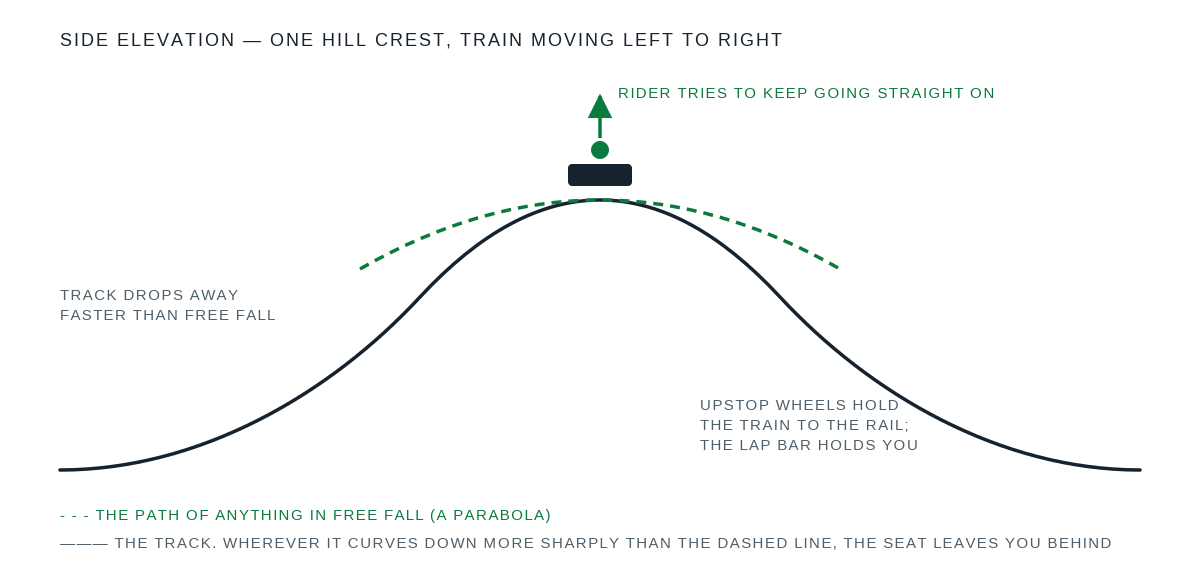
The crossing point between the two is a matter of arithmetic: the vertical g at a crest is 1 − v²/(r × g), where v is speed, r is the radius of the crest and g is 9.81 m/s². Zero g arrives when v²/r equals g. Notice what that means: speed matters twice over, because the faster the train, the larger the radius needs to be to keep the same sensation.
Three radii, three kinds of airtime
Take one train at 20 m/s (72 km/h, 45 mph) and pass it over three crests. A gentle crest of 80 m radius still presses you into the seat at about +0.5 g, which feels like a lightening rather than a lift. A 40 m crest gives roughly zero: the floater. A tight 20 m crest gives about −1 g, a firm shove against the restraint: the ejector. (These are rounded illustrations of the formula, not measurements of any ride.)
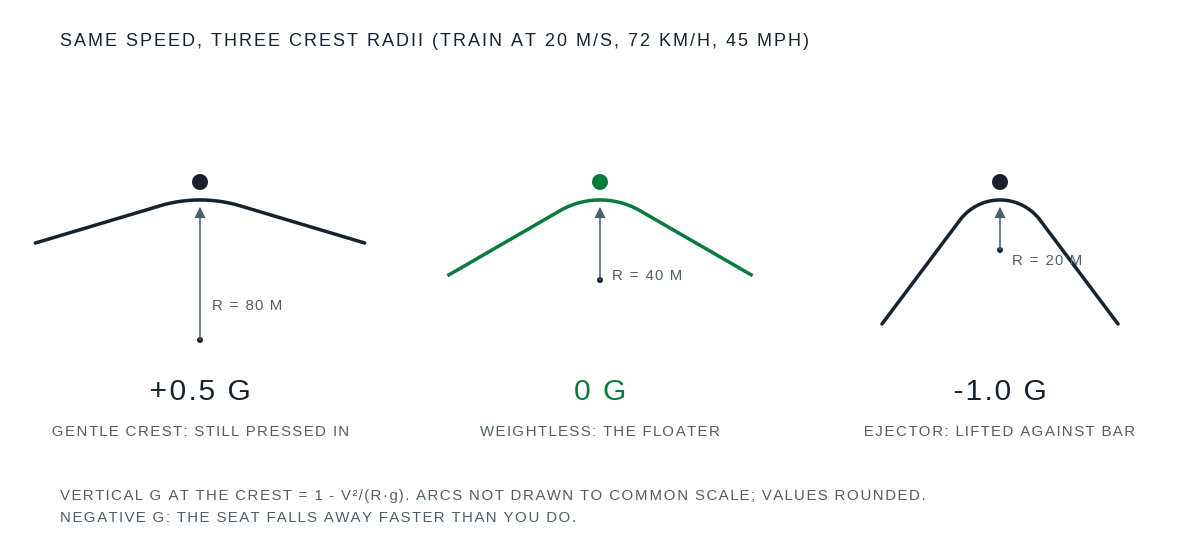
Floater airtime is the one enthusiasts describe as drifting: smooth, long, almost calm. Ejector airtime is the sudden, violent kind, which is why it comes with a verdict of its own on forums and, as we’ll see, a requirement for a firmer restraint. Neither is “better”; they suit different layouts.
Why camelbacks get shorter, and tighter
A camelback is a hill with a hump (or two) and a valley between it and the next. A row of them is the standard way to deliver airtime on a hyper coaster, and the design problem repeats at every crest.
Each hill costs the train height: friction and air resistance only take energy out. So every crest is lower, and slower, than the one before. Keep the same radius on a slower train and the sensation weakens or turns into a limp bump. The designer has to tighten the crest radius progressively to hold the feeling steady — one reason these layouts look like a decreasing sequence of hills. Fig. 3 plots an idealised, frictionless version of the effect.
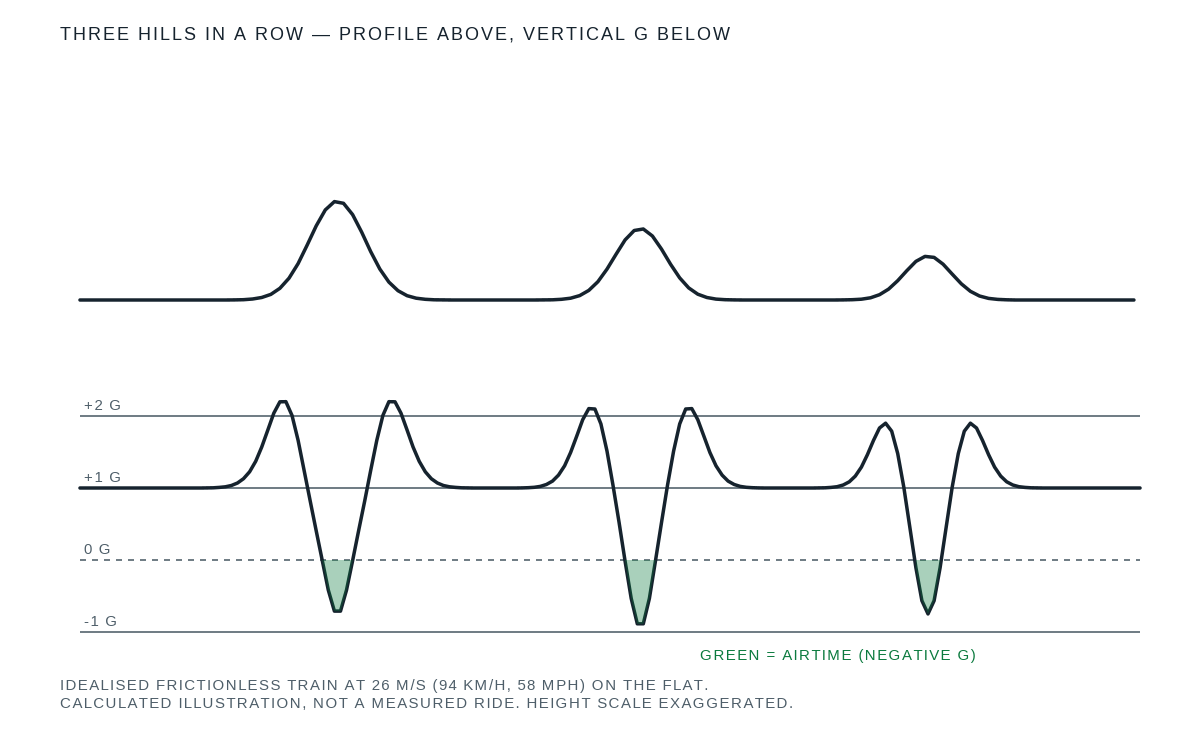
The valleys do something just as important. Notice the g peaks either side of each dip in the figure. Those are the compressions that bracket the airtime, and the transition between them has to be eased in: change too abruptly from +2 g to below zero and the ride is rough rather than thrilling. Good designers smooth that transition the same way loop designers use a clothoid; the track is a stack of calculated curves rather than a series of arcs.
What holds you down
Negative g is a restraint problem as well as a shape problem. Something has to stop a rider leaving the train when the seat quits pushing.
On the train, the answer starts underneath. The upstop wheels on a three-wheel truck are what keep the train on the rail when the track drops away from it; the same wheel that stops a loop pulling a train off its rail stops a hill crest doing so too. For the rider, it’s the lap bar, T-bar or belt. Restraints are sized to the forces a layout produces, and airtime pushes you straight up, which a simple lap bar resists well. Tight ejector crests ask more of them, which is why restraint fit matters so much on airtime-heavy rides.
The restraint is also the part where comfort and thrill pull in opposite directions. A bar that holds you lightly makes floater airtime feel generous; one that grips tightly makes ejector airtime feel firm. Park and manufacturer choices here are quietly some of the biggest influences on how a hill feels.
Where you’ll find it
The pattern is easiest to see on rides built for it.
| Ride | Park | Builder | Notes |
|---|---|---|---|
| Silver Star | Europa-Park, Germany | B&M hyper coaster | 73 m (239 ft), 127 km/h (79 mph); a string of camelbacks on lap bars, as covered in our restraints guide |
| Shambhala | PortAventura, Spain | B&M hyper coaster | 76 m (249 ft) lift, 134 km/h (83 mph), opened 12 May 2012; individual lap bars and an out-and-back layout of airtime hills |
| Wodan Timburcoaster | Europa-Park, Germany | Great Coasters International | 40 m (131 ft), 100 km/h (62 mph), T-bar restraints, up to 3.5 g; airtime from a wooden layout |
| Steel Vengeance | Cedar Point, USA | RMC | 62 m (205 ft), 119 km/h (74 mph); a steel I-Box track on a rebuilt wooden structure, with repeated airtime hills |
Specs are taken from RCDB where it was reachable (Wodan), and from Wikipedia and park material for the others; where sources disagreed or were unavailable we’ve left the figure out.
The comparison between the first and last is instructive. B&M’s hypers are built around long, high-speed hills. Wooden and RMC hybrid coasters are built on a different structure and track, and put their airtime in a different rhythm of hills; our wood vs steel piece covers what changes.
The Dispatch verdict
Airtime is the one coaster sensation that gets delivered by taking something away. The clever part is that the same piece of geometry produces it, floating and ejecting alike; a designer is choosing a radius and a speed rather than adding a gimmick. Next time you float over a crest, that isn’t the train lifting you. It’s the train getting out of the way a fraction faster than you can follow, and a lap bar politely reminding you that you’re still invited.
Further reading: how roller coaster loops are engineered, how restraints are matched to forces, how the wheels keep trains on the track, wood vs steel vs RMC hybrid, and how lift hills build the energy for all of it.